
Milwaukee Film Festival 2025
Milwaukee Film Festival is celebrating 17 years, with official festivities starting on April 24, 2025. The festival will screen over 200 films until May 8, 2025. Artistic Director Cara Ogburn said the Milwaukee Film team preps for the festival by doing lots of research, which includes tracking films and attending other film festivals to see what audiences are interacting with the most.
“There’s nothing like the communal experience,” Ogburn said about the perks of film festivals.
Ogburn said the Milwaukee Film Festival looks for a diverse mix of films that reflect what’s top of mind for Milwaukeeans while focusing on variety by avoiding similar selections.
“There are so many film festivals…so for Milwaukee not to have one would be a shame,” said Ogburn. “…Milwaukee deserves it.”
After months of submissions, film watching, outreach, and marketing, the full list of screenings is out. One of those screenings includes the documentary, Stand Together as One. The documentary explores how many aspects came together to spark the world to fight back against the 1980s famine in Ethiopia.
Stand Together as One is written by Chip Duncan and produced by Duncan and Salim Amin. Duncan has over 45 years of film experience and resides in Milwaukee.
The Power of Media
The documentary is broken into three parts: The Famine, The Music, and The Impact.
Stand Together as One explores the different aspects that came into play to encourage the world to focus on Ethiopia in the 1980s, where millions of people were denied food relief.
A big part of the documentary focuses on the late Kenyan photojournalist Mohamed Amin. Stand Together as One Amin highlights how he defied odds by legally crossing government lines and went to inaccessible areas of Ethiopia to capture footage of hundreds of thousands of Ethiopians who were dying of starvation.
According to the documentary, Amin, along with his BBC colleagues Michael Buerk and Mike Wooldridge ,were the first to broadcast Ethiopia’s famine to the world. The three men documented the true defestations Ethiopians experienced while people around the world enjoyed the “luxuries” of being able to eat whenever they wanted to.
“It all began with the power of photojournalism,” said Duncan. “…that truth is in the photo itself…everyone knew it was a famine there, but no one documented it.”
Stand Together as One used the original footage coverage shot by Amin, Burerk and Wooldridge and walks the viewer down the journey of how millions of dollars were raised to help end the famine happening in Ethiopia during the 1980s.
“[The coverage] became undeniable proof,” said Duncan.
Although the documentary highlights the power of photojournalism, it also shows how it can be seen as exploitive. The documentary shows a past interview with an international Red Cross nurse who worked in Ethiopia during the famine. The nurse was asked about how she feels when she has to turn kids away from receiving food. The footage illustrates her frustration with the question and the reporter because she felt the answer was obvious; she was devastated.
According to the documentary interviews, from the reporter’s perspective, he wanted to make it plain and clear to viewers back home that what was happening in Ethiopia was real and inhumane. From a human being’s perspective, the question at hand in those types of situations usually rubs the interviewee the wrong way.
Stand Together as One can spark many questions, such as how far the media should go for a story, and at what point do journalists put the human being first and the questions second.
The Power of Music
The second part of the documentary focuses on the role of how music amplified the message that the world must do something. Most people know the hit song, “We Are The World,” but it isn’t often talked about why the song was created. Stand Together as One breaks down how music became involved, leading to millions of dollars being raised for the innocent people of Ethiopia.
“We wanted to [show that] the music existed because of the famine,” said Duncan.
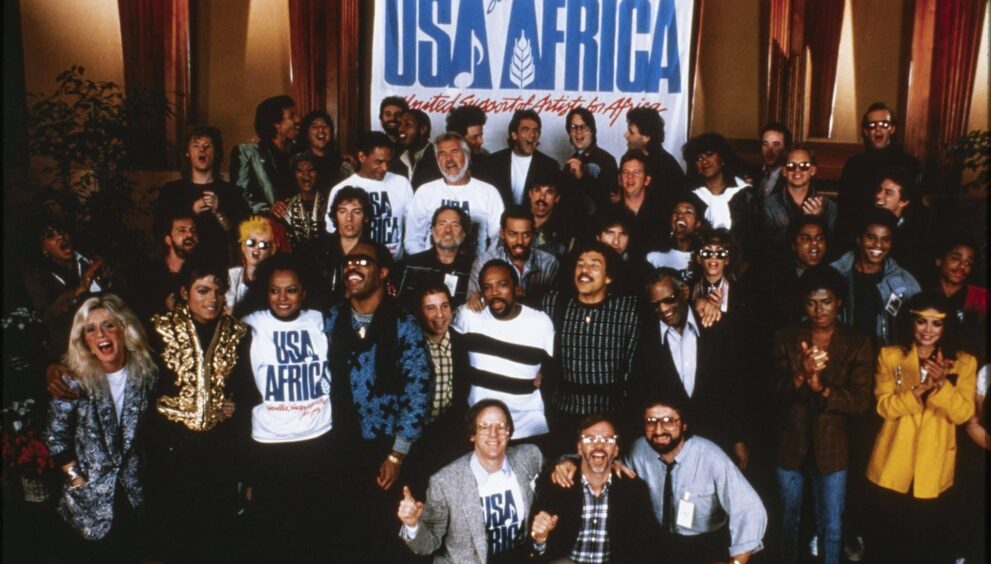
Once BBC aired the coverage shot by Amin, Burerk, and Wooldridge, Bob Geldof was inspired to do something, so he led the Band Aid campaig,n which is primarily known for its iconic song, “Do They Know It’s Christmas?” featuring top London artists at the time. The initiative was created to raise funds for anti-famine efforts in Ethiopia in 1984. Geldof then teamed up with artist and activist Harry Belafonte, artistLionel Richie, and late legend and producer Quincy Jones to bring together top American artists, including Michael Jackson, for the making of We Are The World.
2025 marks 40 years after the recording of We Are The World. It was mentioned in the documentary that We Are The World was probably so successful because the song never explicitly mentioned Africa. The song did spark thousands of people to donate money and find ways to give back to Ethiopia.
Stand Together as One‘s goal is to show what happens when creatives come together.
The Impact
Stand Together as One ended with part three: the impact of the many efforts held to end the famine. Through Live Aid and USA Africa, over $100 million was raised. Since then, both organizations have continued their efforts and have expanded services.
Even with the money raised and the world’s attention on Ethiopia for a moment in time, Ethiopia is still experiencing food shortages and a lack of resources. Yet, progress has been made, and the communities continue to grow through it all.
This documentary does not downplay the suffering of over seven million Ethiopians. It instead shows the depth of how innocent people were treated, while also highlighting what can happen when people come together for the good of others.
It should be noted that it doesn’t have to take an international crisis to happen for you to make a difference in someone else’s life. We all can make a positive difference through small gestures.
Stand Together as One is screening at the Milwaukee Film Festival on April 25, 2025, and May 7, 2025. Tickets to the 2025 Milwaukee Film Festival can be found here.