

A Milwaukee Mom
Ashley Curry was pregnant with her fifth child when she had to quit her job at the hospital because the work became too difficult as she was growing a new human being inside of her. Curry, who is a single mom, was emotionally stressed out. With four other children to feed at home and bills to pay, Curry wasn’t sure where she could turn to for help. Even with a great support system of family, Curry needed additional help as she prepared for the birth of her son.
Curry was recommended by her friend to check out The Bridge Project in Milwaukee through the Zilber Family Foundation. The Bridge Project invests directly in early childhood by providing expectant mothers with unrestricted financial support. The Bridge Project was originally launched in New York and was brought to Milwaukee earlier this year by the Zilber Family Foundation, a private, independent grantmaking institution dedicated to enhancing the well-being of individuals, families, and neighborhoods.
In April 2024, The Bridge Project opened applications to help 100 Milwaukee low-income, expectant mothers with unrestricted cash for the first two years of their child’s life. Curry was one of the 100 Milwaukee moms selected for the program. When applying, Curry thought the program was a scam because it seemed too good to be true until she saw the benefits firsthand.
“The program is good for resources…you’re able to talk to people when you need it,” said Curry.
Along with receiving monthly stipends, Curry received additional resources like baby supplies and opportunities to connect with other local moms. This Fall, Curry attended a panel to listen to mothers who are in similar situations. In moments like these, Curry knows she is not alone in her journey of motherhood.
Curry was 26 weeks pregnant when she applied for The Bridge Project. Her son Jaxon is now five months old and is getting to know his four siblings, aged nine, five, four, and two years old.
“They should keep funding [The Bridge Project] because it’s helpful. It helped me in a lot of ways to get prepared for my child,” said Curry.
Expanding The Bridge Project in Milwaukee
Originally, the Zilber Family Foundation donated almost $1.6 million to bring The Bridge Project to Milwaukee. The donation secured two years of cash transfers for Milwaukee mothers. The Bridge Project usually has cohorts for three years. According to a press release, on November 26, 2024, the Zilber Family Foundation announced the extension of the program to support moms for a third year with the City of Milwaukee’s allocation of $350,000 in American Rescue Plan Act (ARPA) funds.
In addition to those funds, The Bridge Project received an anonymous donation of $450,000. The donation will allow for an additional 22 expectant mothers to join the existing 100 Milwaukee mothers in the program. With such a high demand to be in the program, applications were only open for one week.
The Bridge Project chooses its moms based on a lottery system. Zilber Family Foundation Executive Director Gina Stilp has stood firm on not policing moms on how they choose to spend the stipends, which she said has brought great results in the mothers’ lives.
“I have a choice on how I spend my resources…and moms and families have the right to make those decisions,” said Stilp. “People are uncomfortable not knowing that every dime didn’t go to food and diapers…yes, it makes us uncomfortable, and that’s okay…we don’t need to understand everything.”
The Bridge Project is meant to put the well-being of the child first, and that involves ensuring the mother is good, too.
According to the American Journal of Managed Care, of all countries in 2020, the United States had the highest infant mortality rate at 5.4 deaths per 1,000 live births. As maternal and infant mortality are on a constant rise in this country, resources like The Bridge Project are needed to fight those numbers, but they can’t do it alone.
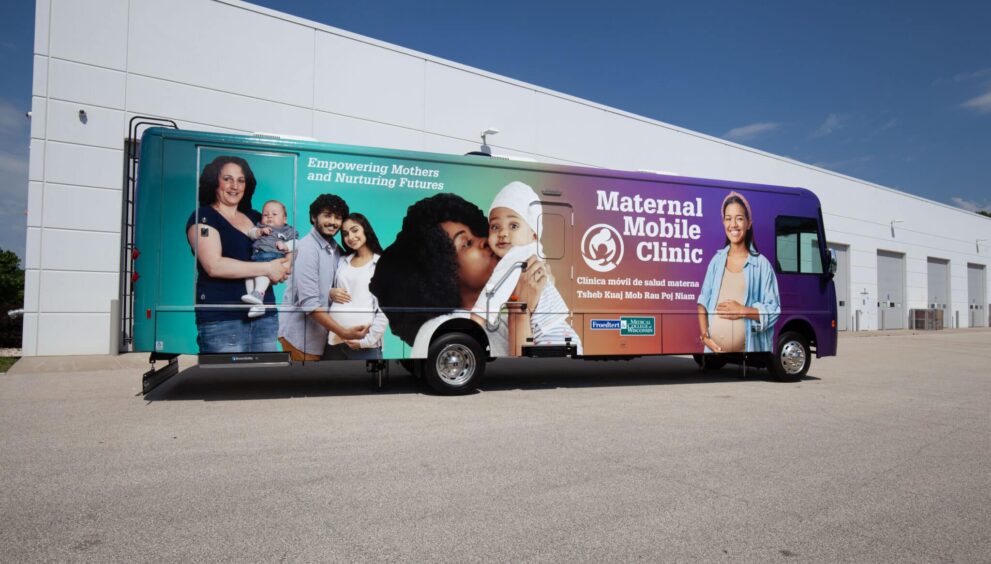
Froedtert and Medical College of Wisconsin’s Maternal Mobile Clinic is too fighting the fight to save Milwaukee mothers and their babies.
Maternal Mobile Clinic
The Maternal Mobile Clinic started servicing the Milwaukee community this summer. The mobile clinic allows Froedtert to bring important maternal health services directly to communities, making health care accessible and convenient for prenatal and postpartum care.
The Maternal Mobile Clinic Provides:
- Prenatal exams
- Postpartum exams
- Family planning
- Vaccine administration
- STI screening
- Postpartum depression screening
- Access to psychiatric and psychological services
- Access to lactation services
- Access to social services
It was around 2004 when Lauri Diske had the idea for the Maternal Mobile Clinic. Diske, Director of Women’s Health for Froedtert Hospital, said the city was experiencing a high number of infant deaths, which has improved over the years. Now, the city is experiencing high maternal deaths, with COVID-19 playing a role in those rates. Diske said Milwaukee mothers are dying from a multitude of things, including pre-existing health conditions, postpartum bleeding, and Preeclampsia.
Diske gathered a group of community partners to see which locations expecting moms weren’t accessing health resources. Through research and collaboration, the group discovered that zip codes 53206 and 53207 needed the most help.
Based on the data, the Maternal Mobile Clinic makes weekly visits to the most impacted locations in Milwaukee. Most mobile sites come with a midwife.
“We need people to talk about it and say look, we got these great resources in the community and here are the locations,” said Diske.
The Maternal Mobile Clinic Location and Hours:
- Monday: Evolve Church, 10 a.m. – 4 p.m.
- Tuesday: Bay View Community Center, 10 a.m. – 4 p.m.
- Wednesday: Tabernacle Community Baptist Church, 10 a.m. – 4 p.m.
- Thursday: Penfield Children’s Center, 10 a.m. – 4 p.m.
The Sherman Phoenix, a hub for Black entrepreneurs on Milwaukee’s Northside, might be a future mobile clinic location.
“If I can help a mom have a healthy pregnancy, she’s more likely to have a healthy baby,” said Diske.
The Bayview Community Center was a key location for the Maternal Mobile Clinic because it’s a community center that offers a holistic approach to caring for families. Monday through Friday, the center offers art classes, supports groups in English and Spanish, parenting classes, workshops for early childhood educators, and they even have a kitchen incubator for community use.
The center also serves 1,400 individuals a month through its emergency food pantry.
Bayview Community Center Interim Executive Director Diana Billstrom said it’s all about meeting the community where they’re at. Bringing the Maternal Mobile Clinic to their center only made sense.
“It’s important to bring awareness…not all mothers have support at home…so we need the community to be support for them, as well as fathers,” said Billstrom.
She added that prenatal and postpartum services are equally important as family planning and mental health.
“I would like the community…to be there for the mom and be understanding of everything going on in the body…and not judging them,” said Billstrom.
There are tons of data to back up the need for resources like The Bridge Project and the Maternal Mobile Clinic. Both resources are seeking additional funding and partners.